The Oxford Handbook of Central American History by Robert Holden;
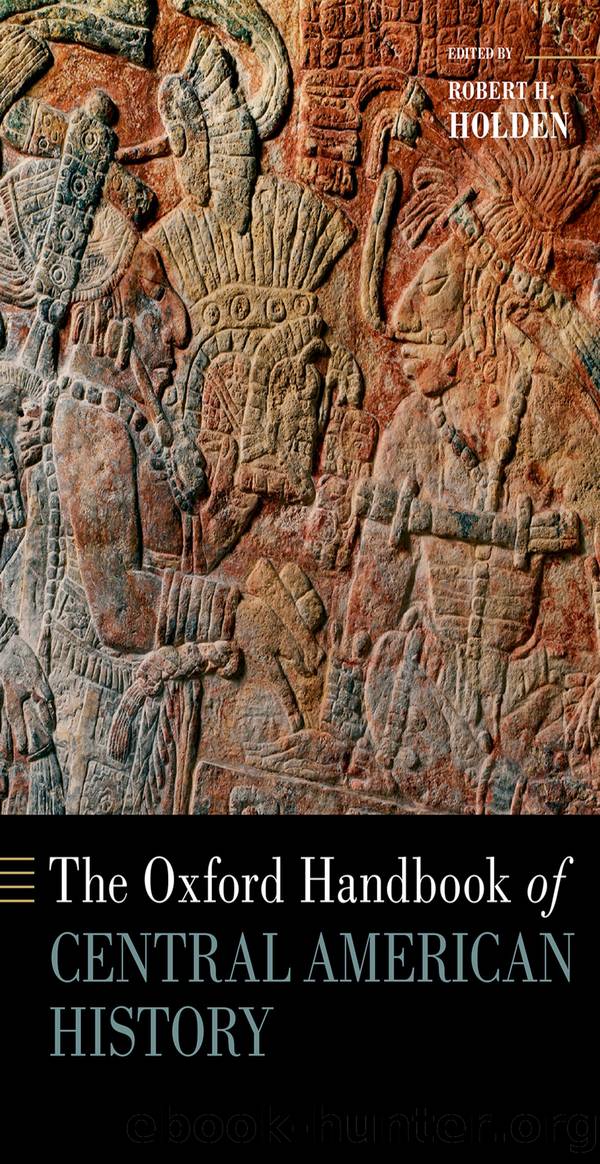
Author:Robert Holden;
Language: eng
Format: epub
Publisher: OUP Premium
Published: 2022-01-15T00:00:00+00:00
The Second Wave of Revolution and the Sandinista Paradigm (1970â1989)
The massive participation of peasant and Indigenous communities in revolutionary politics, the formation of alliances between peasant organizations and urban social movements, and the emergence of powerful guerrilla movements, which were deeply rooted in peasant and urban social movements, were major features of the second wave of revolution in Central America. From the early 1970s onward powerful peasant and Indigenous movements formed coalitions with student, teacher, and worker movements in Guatemala and El Salvador. Elites in both countries responded to these unprecedented urban-rural mobilizations with unabated state terror. In Guatemala a ânew generation of social movements (labor, peasant, Indigenous, community)â demanded socioeconomic and democratic rights for socially excluded Indigenous and Ladino communities. Since 60 percent of the population in Guatemala is Indigenous the intersection between âethnic identity and democratic rightsâ for Indigenous communities was paramount in that country. Guatemalan elites and the state responded to the social mobilizations in the 1970s with a level of repression often âunmatched anywhere in Latin America.â59 Between 1978 and 1985 death squads and military forces killed between 50,000 and 75,000 people in Guatemala.60 In El Salvador, poverty and landlessness fueled the political mobilization of peasant communities that preceded the countryâs civil war.61 The potent peasant organizations formed in the 1970s articulated the socioeconomic demands of landless rural workers and small landholders who worked at large coffee, cotton, and sugar plantations. These peasant organizations formed alliances with urban social movements made up of high school and university students, teachers, workers, and dwellers of marginalized communities in San Salvador. These transclass urban-rural alliances posed a formidable challenge to oligarchic-military authoritarianism in El Salvador. Fiercely anticommunist and paternalistic economic elites considered any labor unrest as subversion and relied on the military and public security forces to repress labor or political mobilizations.62 In the 1970s, state forces perpetrated summary executions and urban and rural massacres to contain the growing social mobilizations. Between 1978 and 1983 state forces killed 42,171 persons or âclose to 1 percent of the population.â63 However, heightened repression proved counterproductive. State terror radicalized the massive social movements in the midst of a major political crisis in the late 1970s. Social activists massively joined or supported guerrilla movements, transforming the small insurgencies created at the beginning of that decade into formidable political and military forces.
Guerrilla movements were also major actors of revolutionary politics in the 1970s. In Guatemala, militants who survived the extermination of guerrilla groups in the 1960s formed a new generation of guerrilla organizations that achieved a much greater development than their predecessors in the previous decade. In the mid-1970s, four guerrilla groups existed in Guatemala: FAR, PGT, the Guerrilla Army of the Poor (EGP), and the Revolutionary Organization of the People in Arms (ORPA). âPeasants, rural and urban workers, artisans and students, and middle-class professionalsâ made up these organizations. The leaders of FAR, EGP, and ORPA were men of middle-class backgrounds. Artisans and middle-class professionals led the PGT.64 The Guatemalan guerrillas in the 1980s
Download
This site does not store any files on its server. We only index and link to content provided by other sites. Please contact the content providers to delete copyright contents if any and email us, we'll remove relevant links or contents immediately.
Hyperculture by Byung-Chul Han(632)
The European Opportunity by Felipe Fernández-Armesto(625)
Morgan Kaufmann Digital Watermarking and Steganography by Ingemar Cox Matthew Miller Jeffrey Bloom Jessica Fridrich Ton(615)
The European History Highway: A Guide to Internet Resources by Dennis A. Trinkle Scott A. Merriman(583)
The Seven Wonders of the Ancient World by Michael Denis Higgins(571)
European Security without the Soviet Union by Stuart Croft Phil Williams(550)
The Routledge companion to Christian ethics by D. Stephen Long Rebekah L. Miles(546)
European Security in a Global Context by Thierry Tardy(545)
Get Real with Storytime by Julie Dietzel-Glair & Marianne Crandall Follis(500)
Gorbachev And His Generals by William C. Green(484)
Hudud Al-'Alam 'The Regions of the World' - a Persian Geography 372 A.H. (982 AD) by V. V. Minorsky & C. E. Bosworth(480)
Inheriting Walter Benjamin by Gerhard Richter;(477)
Tibetan Studies in Comparative Perspective by Chih-yu Shih Yu-Wen Chen(472)
CliffsNotes on Fitzgerald's The Great Gatsby by Kate Maurer(466)
Governance, Growth and Global Leadership by Espen Moe(466)
The Master Builder by Henrik Ibsen--Delphi Classics (Illustrated) by Henrik Ibsen(461)
How Languages Are Learned 5th Edition by Patsy M Lightbown;Nina Spada; & Nina Spada(453)
The Oxford History of the World by Fernández-Armesto Felipe;(436)
The Egyptian Economy, 1952-2000 by Khalid Ikram(422)
